JavaScript Unicode Character Value Finder — charCodeAt & fromCharCode Project 2026
Build a Unicode Character Value Finder using JavaScript charCodeAt, codePointAt, fromCharCode, and fromCodePoint. Learn how characters map to numbers and handle emoji surrogate pairs.
Build an interactive tool that takes any character and displays its Unicode code point, UTF-16 code units, and binary representation using core JavaScript string methods.
How Characters Map to Numbers
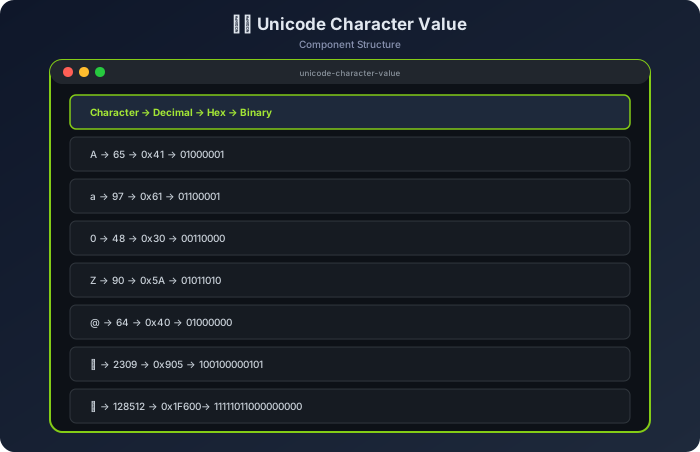
Pattern: A–Z = 65–90, a–z = 97–122, 0–9 = 48–57. Uppercase and lowercase differ by 32.
Emoji like 😀 have code points above U+FFFF. JavaScript's UTF-16 uses two code units (a surrogate pair) to represent them:
javascript example
const emoji = "😀";
console.log(emoji.length);           // 2 code units
console.log(emoji.codePointAt(0));   // Full code point
console.log(Array.from(emoji).length); // 1 actual character
Always use codePointAt() and Array.from() when your code handles emoji.
Key Takeaways
Unicode assigns a unique number to every character across all languages and symbol sets — solving cross-platform text compatibility.
charCodeAt() returns a UTF-16 code unit (max 65535) — works for basic characters but breaks for emoji.
codePointAt() returns the full code point — always prefer this for correct character identification.
fromCharCode and fromCodePoint convert numbers back to characters — use fromCodePoint for full Unicode support.
Emoji occupy 2 positions in a JS string due to surrogate pairs — use Array.from(str) to correctly count characters.
toString(2) and toString(16) reveal binary and hex — essential for understanding encoding at the byte level.
FAQ
Q1: charCodeAt vs codePointAt — when to use which?
Use codePointAt when you need the true character identity (handles all Unicode). Use charCodeAt only when working with raw UTF-16 units (binary protocols, encoding algorithms). For the emoji 😀, charCodeAt(0) gives 55357 (useless high surrogate) while codePointAt(0) gives 128512 (the actual code point).
Q2: Why does "😀".length return 2?
JavaScript's .length counts UTF-16 code units, not visible characters. Since 😀 (U+1F600) exceeds U+FFFF, it needs two 16-bit code units. Fix: Array.from("😀").length returns 1.
Array.from iterates by code points (not UTF-16 indices), so emoji are handled as single characters.
Exam Focus
Revise definitions, diagrams, examples, and short-answer points for JavaScript Unicode Character Value Finder — charCodeAt & fromCharCode Project 2026.
Interview Use
Prepare one clear explanation, one practical example, and one common mistake for this JavaScript Master Course topic.