JavaScript Notes
Deep dive into JavaScript scope: global scope, function scope, block scope, lexical scope, scope chain, TDZ, variable shadowing. With memory diagrams, examples, and interview Q&A.
What is Scope?
Scope in JavaScript determines the accessibility and visibility of variables, functions, and objects in your code during runtime. It defines the region of your program where a variable can be referenced and accessed.
Think of scope as a set of rules that governs how the JavaScript engine looks up variables. When you reference a variable, the engine needs to know where to find it — scope provides that answer.
Types of Scope
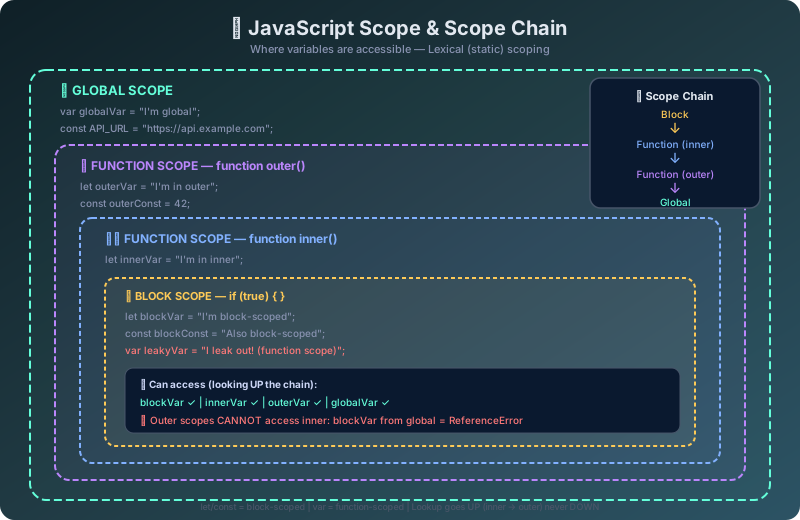
JavaScript has four types of scope:
- Global Scope - Variables accessible everywhere
- Function Scope - Variables accessible only within a function
- Block Scope - Variables accessible only within a block (ES6+)
- Module Scope - Variables accessible only within a module
Global Scope
Variables declared outside any function or block exist in the global scope. They are accessible from anywhere in your code.
var globalVar   = "I am global";
let globalLet   = "I am also global";
const globalConst = "I am global too";

function accessGlobal() {
  console.log(globalVar);
  console.log(globalLet);
  console.log(globalConst);
}

accessGlobal();
console.log(window.globalVar); // "I am global" — var becomes window property
console.log(window.globalLet); // undefined — let does NOTI am global I am also global I am global too I am global undefined
In browser environments, var declarations at the top level become properties of the window object. let and const do not.
Global Scope Memory Diagram
+-------------------------------------------+
|           GLOBAL SCOPE                     |
|  window.globalVar = "I am global"          |
|  globalLet = "I am also global"            |
|  globalConst = "I am global too"           |
|                                            |
|  +-------------------------------------+  |
|  |      FUNCTION: accessGlobal         |  |
|  |      (can access all above)         |  |
|  +-------------------------------------+  |
+-------------------------------------------+
Problems with Global Scope
var name = "Alice";

function greet() {
  message = "Hello " + name; // No declaration = implicit global
  console.log(message);
}

greet();
console.log(window.message); // "Hello Alice" - leaked!
Function Scope
Variables declared inside a function are only accessible within that function.
function calculateArea() {
  var width  = 10;
  let height = 20;
  const unit = "px";

  console.log(`Area: ${width * height} ${unit}`);
}

calculateArea();
// console.log(width);  // ReferenceError
// console.log(height); // ReferenceErrorArea: 200 px
var is Function-Scoped
function example() {
  if (true) {
    var x = 10; // function-scoped — leaks out of if block
    let y = 20; // block-scoped — stays inside if
  }

  console.log(x); // 10 - accessible!
  // console.log(y); // ReferenceError
}

example();10
Nested Function Scope
function outer() {
  var outerVar = "outer";

  function middle() {
    var middleVar = "middle";

    function inner() {
      var innerVar = "inner";
      console.log(outerVar);  // accessible
      console.log(middleVar); // accessible
      console.log(innerVar);  // accessible
    }
    inner();
  }
  middle();
}

outer();outer middle inner
Block Scope (ES6+)
let and const are block-scoped. A block is any code within curly braces {}.
if (true) {
  let blockLet   = "block only";
  const blockConst = "also block only";
  var notBlockScoped = "escapes block";
}

console.log(notBlockScoped); // "escapes block"
// console.log(blockLet);    // ReferenceError
// console.log(blockConst);  // ReferenceError
Block Scope with Loops
var: 3
var: 3
var: 3
let: 0
let: 1
let: 2
Plain Block Scope
{
  let x = 42;
  const y = "secret";
  console.log(x, y); // 42 "secret"
}
// console.log(x); // ReferenceError
Lexical Scope (Static Scope)
JavaScript uses lexical scoping — scope is determined by where functions are written in source code, not where they are called.
let name = "Global";

function outer() {
  let name = "Outer";

  function inner() {
    console.log(name); // Looks in lexical parent
  }

  return inner;
}

function another() {
  let name = "Another";
  const fn = outer();
  fn(); // "Outer" - not "Another"
}

another();Outer
Lexical Scope Diagram
Source Code Structure determines lookup:

Global: name = "Global"
  |
  +-- outer(): name = "Outer"
  |     |
  |     +-- inner(): console.log(name)
  |           Lookup: inner -> outer (FOUND "Outer")
  |
  +-- another(): name = "Another"
        Calls inner() but inner was DEFINED inside outer
        So inner uses outer's scope, NOT another's
Scope Chain
When a variable is referenced, JavaScript searches the scope chain from inner to outer scope.
const global = "G";

function first() {
  const a = "A";

  function second() {
    const b = "B";

    function third() {
      const c = "C";
      console.log(c);      // Own scope
      console.log(b);      // Parent scope
      console.log(a);      // Grandparent scope
      console.log(global); // Global scope
    }
    third();
  }
  second();
}

first();C B A G
Scope Chain Resolution Algorithm
Looking up variable 'a' inside third():

1. Check third() local scope     -> NOT FOUND
2. Check second() scope          -> NOT FOUND
3. Check first() scope           -> FOUND! Return "A"
4. (Would check Global if not found)
5. (ReferenceError if not found anywhere)
Temporal Dead Zone (TDZ)
Variables declared with let and const exist in a TDZ from the start of their block until the declaration is reached.
console.log(a); // undefined (var hoisted + initialized)
// console.log(b); // ReferenceError (TDZ)
// console.log(c); // ReferenceError (TDZ)

var a = 1;
let b = 2;
const c = 3;
TDZ Visualization
{                    // TDZ starts for x
  // x is in TDZ
  // accessing x throws ReferenceError

  let x = 10;       // TDZ ends, x = 10
  console.log(x);   // Safe: 10
}
TDZ with typeof
console.log(typeof undeclared); // "undefined" - safe
// console.log(typeof tdzVar); // ReferenceError!
let tdzVar = "hello";
Variable Shadowing
When an inner scope variable has the same name as an outer scope variable.
let x = 10;

function demo() {
  let x = 20; // Shadows outer x
  console.log("Function:", x);

  if (true) {
    let x = 30; // Shadows function x
    console.log("Block:", x);
  }

  console.log("After block:", x);
}

demo();
console.log("Global:", x);Function: 20 Block: 30 After block: 20 Global: 10
Illegal Shadowing
// This is ILLEGAL:
function bad() {
  let x = 10;
  if (true) {
    // var x = 20; // SyntaxError! var would escape block and re-declare let
  }
}

// This is LEGAL:
function good() {
  var x = 10;
  if (true) {
    let x = 20; // OK - let stays in block
    console.log(x); // 20
  }
  console.log(x); // 10
}
Module Scope
ES6 modules have their own scope. Top-level declarations don't become global.
IIFE for Scope Isolation
(function() {
  var private = "hidden";
  console.log(private); // "hidden"
})();
// console.log(private); // ReferenceError

// Named IIFE
(function init() {
  const config = { debug: false, version: "2.0" };
  console.log("Initialized:", config.version);
})();
Scope Comparison Table
| Feature | var | let | const |
|---|---|---|---|
| Scope | Function | Block | Block |
| Hoisting | Yes (undefined) | Yes (TDZ) | Yes (TDZ) |
| Re-declaration | Allowed | Not allowed | Not allowed |
| Re-assignment | Allowed | Allowed | Not allowed |
| window property | Yes | No | No |
| TDZ | No | Yes | Yes |
Common Mistakes
Mistake 1: var is not block-scoped
Mistake 2: Accidental globals
function oops() {
  leaked = "global now"; // Missing let/const/var
}
oops();
console.log(leaked); // "global now"
Mistake 3: TDZ confusion
let value = "outer";
function test() {
  // console.log(value); // ReferenceError (TDZ from block start)
  let value = "inner";   // This shadows and creates TDZ above
  console.log(value);    // "inner"
}
Common Traps 🪤
| Pattern | Unexpected Behavior | Fix |
|---|---|---|
for(var i...) callbacks | All see final i value | Use let i |
if{var x} outside | x accessible outside if | Use let |
| No declaration keyword | Accidental global variable | Use strict mode |
| TDZ shadow | Inner let shadows outer before line | Rename or reorder |
for...in + var | Loop variable leaks to outer | Use let |
Interview Questions
Q1: Output?
var x = 1;
function foo() {
  console.log(x);
  var x = 2;
}
foo();
Answer: undefined — local var x is hoisted, shadows global.
Q2: Output?
let a = 1;
{
  console.log(a);
  let a = 2;
}
Answer: ReferenceError — TDZ for inner let a.
Q3: Output?
Answer: 3 then ReferenceError.
Q4: Explain scope chain
Answer: The scope chain is the ordered list of variable objects that the engine searches when resolving a variable name. It starts with the current scope and extends outward through each enclosing scope until reaching global.
Q5: Output?
function outer() {
  var x = 10;
  function inner() {
    console.log(x);
  }
  x = 20;
  return inner;
}
outer()();
Answer: 20 — closure captures the variable reference, not the value at creation time.
Best Practices
- Always use
constby default,letwhen reassignment needed - Never use
varin modern code - Minimize global variables to avoid collisions
- Use modules for encapsulation
- Declare variables at the top of their scope
- Avoid shadowing unless intentional
- Use strict mode to catch accidental globals
Summary
| Concept | Key Point |
|---|---|
| Global Scope | Accessible everywhere, pollutes namespace |
| Function Scope | var lives within entire function |
| Block Scope | let/const live within {} |
| Lexical Scope | Determined by source code position |
| Scope Chain | Inner to outer variable lookup |
| TDZ | let/const inaccessible before declaration |
| Shadowing | Inner variable hides outer same-name |
| Module Scope | Top-level stays private to module |
Practice Exercises
- Predict outputs of nested scope examples
- Refactor var code to use let/const properly
- Identify scope bugs and fix them
- Create module with controlled public API
- Demonstrate all four scope types in one file
Exam Focus
Revise definitions, diagrams, examples, and short-answer points for Scope in JavaScript — Complete Guide with Examples 2026.
Interview Use
Prepare one clear explanation, one practical example, and one common mistake for this JavaScript Master Course topic.
Search Terms
javascript-complete-guide, javascript master course, javascript, complete, guide, advanced, scope, scope in javascript — complete guide with examples 2026
Related JavaScript Master Course Topics