JavaScript Notes
Learn to build an expense tracker in JavaScript with income/expense entries, balance calculation, category filtering, chart visualization, and localStorage.
What You'll Learn
- How to distinguish income vs. expense entries with signed amounts
- How to use
Array.reduce()to calculate balance, total income, and total expenses - How to categorize transactions and filter by category
- How to format currency using
Intl.NumberFormat - How to persist transaction history with
localStorage
Project Overview
An expense tracker records money going in (income) and out (expenses). It displays a running balance and a breakdown of all transactions. The core math is done with Array.reduce() — one of JavaScript's most powerful array methods.
Component Structure
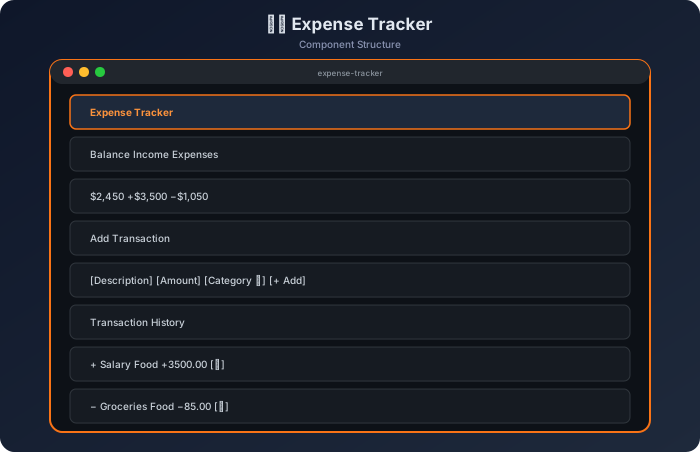
How It Works — Flow Diagram
Step-by-Step Build
Step 1 — HTML Structure
<div class="tracker">
  <h1>Expense Tracker</h1>

  <div class="summary-cards">
    <div class="card card-balance">
      <h3>Balance</h3>
      <p id="balance">$0.00</p>
    </div>
    <div class="card card-income">
      <h3>Income</h3>
      <p id="totalIncome">+$0.00</p>
    </div>
    <div class="card card-expense">
      <h3>Expenses</h3>
      <p id="totalExpense">−$0.00</p>
    </div>
  </div>

  <form id="txnForm" class="txn-form">
    <input type="text"   id="txnDesc"   placeholder="Description" required>
    <input type="number" id="txnAmount" placeholder="Amount (negative = expense)" step="0.01" required>
    <select id="txnCategory">
      <option value="Food">Food</option>
      <option value="Transport">Transport</option>
      <option value="Utilities">Utilities</option>
      <option value="Entertainment">Entertainment</option>
      <option value="Income">Income</option>
      <option value="Other">Other</option>
    </select>
    <button type="submit" class="btn-add">+ Add</button>
  </form>

  <h2>Transaction History</h2>
  <ul id="txnList" class="txn-list"></ul>
</div>
Step 2 — State
Step 3 — Calculate Summary
Step 4 — Format Currency
const fmt = new Intl.NumberFormat("en-US", {
  style: "currency",
  currency: "USD"
});

function formatAmount(n) {
  return (n >= 0 ? "+" : "") + fmt.format(n);
}
Step 5 — Render
Step 6 — Add Transaction
Step 7 — Delete Transaction
Step 8 — Persistence
function saveTxns() {
  localStorage.setItem("transactions", JSON.stringify(transactions));
}
Step 9 — Initialize
render();Console Output
// Add income: Salary +3500
transactions = [{ id: 1749686400000, desc: "Salary", amount: 3500, category: "Income" }]
calculateSummary() → { balance: 3500, income: 3500, expense: 0 }
DOM: Balance $3,500.00 | Income +$3,500.00 | Expenses $0.00

// Add expense: Groceries −85
transactions = [..., { desc: "Groceries", amount: -85, category: "Food" }]
calculateSummary() → { balance: 3415, income: 3500, expense: -85 }
DOM: Balance $3,415.00 | Expenses −$85.00

// Delete Groceries
transactions = [Salary only]
calculateSummary() → { balance: 3500, income: 3500, expense: 0 }
Edge Cases to Handle
| Situation | Expected Behavior |
|---|---|
| Amount of 0 | Technically valid but possibly a user mistake — show warning |
| Non-numeric amount | isNaN() check blocks submission |
| Negative balance | Balance turns red |
| Empty transactions | Show "No transactions yet" |
| Page refresh | Data loads from localStorage |
Challenge Yourself
- Category pie chart — use Canvas API or a library to visualize spending by category
- Monthly view — group and summarize transactions by month
- CSV export — download all transactions as a spreadsheet
- Budget limits — set a monthly budget cap per category with alerts
- Multi-currency — add a currency selector with live exchange rates via an API
Best Practices
- Use
Array.reduce()for aggregation — don't maintain running totals manually - Always call both
saveTxns()andrender()after mutations - Show the transaction list in reverse chronological order (newest first)
- Use
Intl.NumberFormatfor locale-correct currency formatting - Sign convention: positive = income, negative = expense — keep it consistent
Exam Focus
Revise definitions, diagrams, examples, and short-answer points for Build a JavaScript Expense Tracker - Step by Step Project Tutorial.
Interview Use
Prepare one clear explanation, one practical example, and one common mistake for this JavaScript Master Course topic.
Search Terms
javascript-complete-guide, javascript master course, javascript, complete, guide, mini, projects, expense
Related JavaScript Master Course Topics