JavaScript Notes
Learn to build an employee CRUD database app in JavaScript with add, edit, delete, search, sort, and localStorage persistence. Great intermediate JS project.
What You'll Learn
- How to implement full CRUD (Create, Read, Update, Delete) with JavaScript
- How to render an array of objects as an HTML table
- How to build a search bar that filters across multiple fields
- How to implement column sorting (ascending/descending)
- How to persist all data with
localStorage
Project Overview
An employee database lets HR manage staff records. Every record has a name, department, role, salary, and status. Users can add new employees via a form modal, edit existing ones, delete records, search by any field, and sort columns.
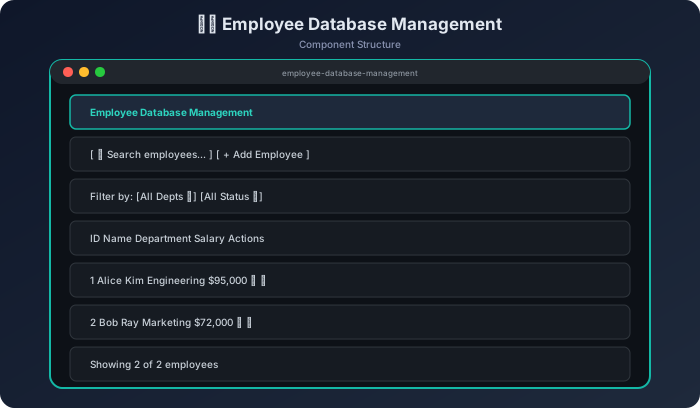
Component Structure
How It Works — Flow Diagram
Step-by-Step Build
Step 1 — Data Model & State
Step 2 — Render Table
Step 3 — Add Employee
Step 4 — Update Employee
Step 5 — Delete Employee
Step 6 — Event Delegation for Table Actions
Step 7 — Search & Filter
Step 8 — Column Sorting
Console Output
// Initial load
loadEmployees() → 3 employees from localStorage
renderTable()   → 3 rows rendered

// Search "engineering"
searchQ = "engineering"
renderTable() → filters to 1 row (Alice Kim)

// Sort by salary
sortKey = "salary", sortAsc = true
renderTable() → rows sorted: Bob $72k, Carol $80k, Alice $95k

// Delete Bob (id: 2)
confirm("Delete this employee?") → true
employees = [Alice, Carol]
saveEmployees() → localStorage updated
renderTable() → 2 rows shown
Edge Cases to Handle
| Situation | Expected Behavior |
|---|---|
| No employees | Show "No employees found" row |
| Search matches zero | Show empty state |
| Delete last employee | Empty table shown |
| Edit and cancel | No changes saved |
| Salary NaN | Validate number input |
Challenge Yourself
- Pagination — show 10 employees per page with Previous/Next navigation
- CSV export — download all employees as a
.csvfile - Import CSV — parse an uploaded CSV to bulk-add employees
- Salary statistics — show average, min, and max salary per department
- Role-based view — different users see different columns (HR vs manager)
Best Practices
- Separate data operations (add/update/delete) from rendering
- Always call
saveEmployees()andrenderTable()together after mutations - Use
Array.findfor single lookups andArray.filterfor multi-result queries - Apply search, filter, and sort as a pipeline in the render function
- Use
confirm()for destructive actions in simple projects; use a modal in production
Exam Focus
Revise definitions, diagrams, examples, and short-answer points for Build a JavaScript Employee Database Management App - Step by Step Tutorial.
Interview Use
Prepare one clear explanation, one practical example, and one common mistake for this JavaScript Master Course topic.
Search Terms
javascript-complete-guide, javascript master course, javascript, complete, guide, mini, projects, employee
Related JavaScript Master Course Topics